
Complete Guide to Exporting Bangladeshi Products to Brazil
Md. Joynal Abdin
Founder & Chief Executive Officer, Trade & Investment Bangladesh (T&IB)
Editor, T&IB Business Directory; Executive Director, Online Training Academy (OTA)
Secretary General, Brazil Bangladesh Chamber of Commerce & Industry (BBCCI)
Bangladesh and Brazil may be separated by a vast geographic distance, but their trade relationship has grown significantly in recent years. Bangladesh’s exports to Brazil have surged rising to about $187 million in FY2024–25, up 26% from $147 million the previous year[1]. This marks a steady upward trend (for reference, exports were $175 million in FY2022–23 and $109 million in FY2021–22[2]). Brazil is increasingly seen as one of Bangladesh’s fastest-growing export markets[3], while Brazil’s own shipments to Bangladesh are much larger (over $2.6 billion annually) due to substantial commodity exports[4]. With Brazil’s economy (around $2.2 trillion GDP) about five times the size of Bangladesh’s ($450 billion), and both countries enjoying large consumer bases, strengthening bilateral commerce offers tremendous opportunities[5]. Brazil is projected to become the world’s 8th largest economy by 2026 (GDP ~$2.47 trillion)[6], meaning a vast market for Bangladeshi exporters. This comprehensive guide examines the key aspects of exporting Bangladeshi products to Brazil from market opportunities and regulations to the support provided by the Brazil-Bangladesh Chamber of Commerce & Industry (BBCCI). The aim is to equip exporters and importers in both countries with up-to-date insights and practical guidance for success in this promising trade corridor.
Overview of Bangladesh–Brazil Trade Relations
Rapid Growth but Large Trade Imbalance: Trade between Bangladesh and Brazil has expanded steadily, reaching about $2.7 billion in total trade in 2024[7][8]. However, this exchange is heavily in Brazil’s favor Bangladesh imports far more from Brazil than it exports. In FY2023–24, Bangladesh imported about $2.66 billion worth of goods from Brazil versus only $147 million exported to Brazil[9][1]. In other words, Brazil’s exports to Bangladesh (mostly essential commodities) were 18 times the value of Bangladesh’s exports to Brazil in that period[9]. This imbalance underscores Bangladesh’s reliance on Brazilian raw materials and the untapped potential for Bangladesh to increase its own exports to Brazil.
Major Trade Commodities: Bangladesh primarily exports manufactured goods to Brazil, whereas it imports agricultural and mineral commodities from Brazil[10][11]. The top Bangladeshi exports to Brazil are dominated by ready-made garments (RMG) items like jerseys, pullovers, cardigans, shirts, trousers, jackets and other apparel[3]. As the world’s second-largest apparel producer, Bangladesh has leveraged its competitive clothing industry to make inroads in Brazil’s apparel market. In FY2024–25, garments accounted for the bulk of the $187 million export value[3]. Other Bangladeshi exports, though smaller in value, include textiles, jute goods, leather footwear, and pharmaceuticals[12]. These non-apparel sectors remain limited so far but represent areas for diversification and growth[13]. On the other hand, Brazil’s exports to Bangladesh consist mainly of raw commodities that feed Bangladesh’s industry and consumers. Key imports are cane sugar, raw cotton, soybeans and vegetable oils, and maize (corn)[4][14]. For example, Brazil (one of the world’s largest sugar and soybean producers) supplies huge quantities of sugar to Bangladesh’s food industry and soybeans for edible oil and animal feed. Brazil is also a major source of cotton critical for Bangladesh’s textile sector making Bangladesh one of the top cotton importers of Brazilian cotton[4][15]. Steel, hides, and chemicals are smaller import categories[16]. This complementarity shows Bangladesh exporting consumer manufactures while importing primary inputs.
Market Significance and New Initiatives: For Bangladesh, Brazil has emerged as a high-potential non-traditional market as it looks beyond North America and Europe. In 2022–23, Bangladeshi exports to Brazil jumped by nearly 60% over the prior year[3], reflecting a strategic push to expand in Latin America. Diplomatic ties have warmed: notably, Brazil’s Foreign Minister paid a first-ever visit to Dhaka in 2024, underscoring Brazil’s keen interest in deeper economic ties[17]. High-level exchanges and events (such as trade expos discussed later) signal a mutual commitment to boost commerce. Both governments recognize the benefit of a more balanced partnership – Bangladesh can reduce its trade gap by exporting more, and Brazil can find new markets for its goods. There is currently no free trade agreement (FTA) between Bangladesh and Brazil (Brazil is part of Mercosur, which Bangladesh is not), so trade occurs under standard WTO tariff terms[11]. This means Bangladeshi goods face high import tariffs in Brazil, especially on apparel often around 25–35% under Mercosur’s Common External Tariff[18] which can make Bangladeshi products pricier in Brazil. Likewise, Brazilian exports to Bangladesh face Bangladesh’s normal tariff rates. To improve market access, the two countries have begun exploring a Preferential Trade Agreement (PTA). In April 2024, Brazil welcomed Bangladesh’s proposal to initiate a Mercosur–Bangladesh PTA as a way to enhance opportunities and eventually ease tariff barriers[18]. Such an agreement could be pivotal, especially since Bangladesh is set to graduate from LDC status in 2026 and will lose some trade preferences elsewhere[19]. In the meantime, Bangladesh’s exporters are navigating the existing tariff structure by focusing on niche advantages and competitive pricing. Despite challenges, Brazil’s huge economy and population (over 210 million people) represent an exciting frontier for Bangladeshi businesses. The Brazilian ambassador to Bangladesh even described Bangladesh as a “new economic giant” in South Asia and has voiced optimism about expanding trade[20]. Overall, the stage is set for stronger Bangladesh–Brazil trade relations, with significant room for growth if exporters can capitalize on the opportunities and manage the market entry requirements.
Key Opportunities for Bangladeshi Exporters in Brazil
Bangladeshi exporters should target sectors where Bangladesh has strengths and Brazil has demand. Below we outline the key product sectors with high export potential, along with recent trends and opportunities:
- Ready-Made Garments (Textiles & Apparel): Apparel is the flagship export from Bangladesh to Brazil and holds the greatest immediate potential for expansion. Brazil is a large importer of apparel it imported around $5.9 billion in textiles and clothing in 2022[21]. Yet Bangladesh currently accounts for only a small share of that: about $150–$175 million annually in recent years[21][1], roughly ~3% of Brazil’s import market. This indicates significant room to grow. Bangladeshi garments (knitwear like t-shirts, sweaters, and woven items like denim pants, shirts, suits, etc.) are globally competitive in price and quality. Recent growth is encouraging Bangladesh’s apparel exports to Brazil surged nearly 60% year-on-year in FY2022–23[3]. With Brazil’s middle class expanding and seeking affordable fashion, Bangladeshi manufacturers can further penetrate this market by partnering with Brazilian importers/retailers and showcasing their products at trade fairs. One challenge is Brazil’s import duty on apparel (since no FTA yet), which can be 25-35%, but Bangladesh’s low production costs often still make the landed price attractive[18]. There is discussion of a PTA to reduce these tariffs in future. In the meantime, strategies like establishing local distribution partnerships or even exploring joint ventures in Brazil (for finishing or assembly) could help mitigate tariff impacts[22][23]. Bottom line: The Brazilian clothing market is huge, and increasing Bangladesh’s modest share of it represents a prime opportunity for export growth.
- Jute and Eco-Friendly Products: Bangladesh is the world’s largest producer and exporter of jute and jute goods (the “Golden Fiber”), and there is untapped potential to sell more jute products to Brazil. With global trends favoring sustainable, plastic-free materials, jute bags, sacks, yarn, and diversified jute products could find a growing niche in Brazil[24][25]. Currently, jute is not a major item in Bangladesh–Brazil trade, but Bangladeshi officials have emphasized jute goods as a priority to help narrow the trade gap[26]. Brazil’s agriculture sector (coffee, cocoa, etc.) uses a lot of sacks and packaging a natural market for Bangladeshi jute sacks and hessian cloth. Eco-conscious consumers in Brazil’s cities might also welcome jute-based shopping bags, rugs, and home décor items. To develop this market, Bangladeshi exporters should highlight jute’s biodegradable nature and possibly work with Brazilian distributors who specialize in eco-friendly products[27]. It’s worth noting that because jute is a plant product, strict phytosanitary rules apply shipments must be pest-free and usually require fumigation and certificates (addressed later in the regulations section)[28][29]. With proper quality control and marketing, “Made in Bangladesh” jute goods can carve out a sustainable materials niche in Brazil.
- Leather Goods and Footwear: Bangladesh has a substantial leather industry and produces millions of shoes and leather products annually. Brazil, meanwhile, has a large domestic demand for footwear in 2022, Brazil imported over $1 billion in footwear from global suppliers[30][31]. This presents an opportunity for Bangladeshi leather footwear exporters to capture more of the Brazilian market. Bangladeshi shoes (both leather and synthetic) are known for good quality at competitive prices and already sell worldwide. Currently, Bangladesh’s direct footwear exports to Brazil are limited, but with the right marketing and perhaps brand partnerships, this could grow[32][33]. One approach could be OEM partnerships e.g. producing shoes for Brazilian brands or retailers under their label, leveraging Bangladesh’s manufacturing efficiency with Brazilian market insight[34]. Likewise, export of other leather goods (bags, belts, wallets) can be explored, especially if tied to fashion or retail chains in Brazil. Trade shows and B2B matchmaking can help connect Bangladeshi manufacturers with Brazilian importers. As always, ensuring products meet Brazilian quality and safety standards (and fashion preferences) is key. Success in this sector would help Bangladesh diversify beyond garments in the Brazilian market.
- Pharmaceuticals and Healthcare Products: Bangladesh’s pharmaceutical sector is a rising star it exports affordable generic medicines to 150+ countries, including highly regulated markets. Brazil has a large pharmaceuticals market and a need for cost-effective generics, making it a promising frontier for Bangladeshi drug makers[35][36]. Right now, Bangladesh’s pharma exports to Brazil are minimal (only a few million dollars), mainly due to regulatory hurdles. Brazil requires medicines to be registered with its health authority (ANVISA) and importers must be licensed[37]. However, Brazilian officials have expressed openness to importing Bangladeshi generics, recognizing their quality and Bangladesh’s strength in this field[38]. A strategic entry path could be partnering with Brazilian pharmaceutical firms or distributors to navigate regulatory approval together[39][40]. For instance, a Bangladeshi company might form a joint venture in Brazil or license products to a Brazilian firm for local production or distribution this can ease trust and compliance issues. Key product opportunities include generic drugs (e.g. antibiotics, paracetamol, antidiabetics, etc.), Active Pharmaceutical Ingredients (APIs), and medical consumables. It’s a long-term play given the complex approval process, but if even a couple of Bangladeshi pharma companies establish a foothold in Brazil, it could open the door for a new high-value export segment. Success here would not only boost export earnings but also build Bangladesh’s reputation in South America as a source of quality healthcare products.
- Other Emerging Sectors: Beyond the big sectors above, Bangladesh has other industries that could incrementally grow exports to Brazil. For example, Bangladeshi ceramics (tiles, tableware) have gained renown globally and could cater to Brazil’s construction and home décor market[41]. Some Bangladeshi ceramic tableware brands already export to Europe; similar opportunities could be pursued in upscale Brazilian hospitality or retail sectors. Plastic products (household goods, packaging, toys) are another area Bangladesh produces these at scale and at low cost, and small volumes have been exported to various markets. Targeted efforts (like participating in trade fairs in Brazil for plastics or consumer goods) could help boost these “non-traditional” exports[42]. Agro-processed foods (tea, snacks, spices) might also find niche demand within Brazil’s diverse consumer base, particularly among South Asian diaspora or health food segments though one must navigate food import regulations. Additionally, IT and service outsourcing is an emerging frontier: while not a physical product export, Bangladeshi IT firms could offer software or back-office services to Brazilian companies in the long run[43]. Language (Portuguese) and time zone differences are challenges, but for certain English-speaking operations of Brazilian multinationals, Bangladeshi BPO services could be appealing. These service exports are still nascent, but they highlight the broader potential of economic collaboration beyond goods. In summary, while apparel will lead the way, Bangladesh can gradually expand a diverse export basket from jute bags to ceramic dishes to generic medicines to tap into Brazil’s large and dynamic market.
Navigating Brazilian Import Regulations and Requirements
Exporting to Brazil entails meeting a number of import regulations, documentation requirements, and standards. Brazilian customs procedures are stringent – proper compliance will ensure your goods clear customs smoothly and reach the buyer without costly delays. Below are the critical regulatory aspects Bangladeshi exporters must consider:
Tariffs and Market Access: Because there is currently no free trade agreement, Bangladeshi exports to Brazil face Brazil’s normal import duties. For many consumer goods (including textiles/apparel), these duties are fairly high often in the 25–35% range due to Mercosur’s common external tariff[18]. This tariff will be applied on the CIF value of the goods and will impact the final price to your Brazilian customer. Exporters should factor these duties into their pricing strategy; even with tariffs, Bangladeshi goods can remain competitive thanks to low production costs, but margin considerations are important. There is optimism that a future Preferential Trade Agreement (PTA) might reduce tariffs[44]. Until then, demonstrating value (quality/price) is key to persuading Brazilian importers. Note that Brazil also imposes internal taxes (such as VAT/ICMS at the state level) on imports, which the importer will handle but these add to the cost structure. It’s wise to discuss with your buyer who will bear which costs (often defined by Incoterms in your contract). Many initial shipments are done on Letter of Credit (L/C) or advance T/T payment terms to manage risk; as partnerships deepen, more flexible credit terms might be possible. Currency is another consideration: transactions are typically in USD (or sometimes Euros) as a stable medium, since dealing directly in Bangladeshi Taka or Brazilian Real is uncommon. Using USD avoids exchange rate volatility between BDT and BRL, but keep an eye on USD/BDT and USD/BRL rates for pricing. Overall, while tariffs present a hurdle, thorough cost planning and clear agreements with the importer can ensure everyone understands the landed cost of the product.
Essential Export Documentation: Brazil has strict documentation requirements for imports – any inconsistencies can lead to customs holding the shipment. As a Bangladeshi exporter, you’ll need to prepare a set of standard shipping documents, typically including: Commercial Invoice, Packing List, Bill of Lading (or Air Waybill), Certificate of Origin, and Insurance Certificate. The Commercial Invoice should be very detailed (in English or Portuguese) listing the buyer and seller info, accurate description of goods, HS codes, quantities, unit prices, total values, currency, and Incoterms (e.g. FOB Chittagong or CIF Santos)[45]. Brazilian Customs will use the invoice to assess duties, so it must reflect the true transaction value. Ensure the Invoice, Packing List, and Bill of Lading all match each other exactly on key details (product descriptions, quantities, weights, etc.)[46][47]. Even small discrepancies (like a typo or a mismatch in the number of packages) can trigger extra inspections in Brazil’s automated risk system[48]. It’s common for Brazil to put shipments through a Yellow Channel (document check) or Red Channel (physical inspection) if anything seems off, causing delays[49]. Double-check all paperwork before dispatch consistency and accuracy cannot be overstated[50]. Also, make sure to include any special certificates relevant to your product. For instance, phytosanitary certificates are required for plant-based products (more on that below), and fumigation certificates if applicable. If your product is subject to any international standards (like ISO, etc.) or requires test reports, have those ready as well. By assembling a complete and precise documentation package, you greatly increase the chances of a smooth customs clearance in Brazil[51].
Import Licenses and Permits: Brazil maintains import licensing requirements for certain categories of goods, especially those related to health, safety, or security. Many products can be imported freely without a prior license, but some do require an import license or permit obtained by the Brazilian importer before shipment[52]. Examples include pharmaceuticals and medical devices, chemicals, certain telecommunications equipment, weapons, some agricultural items, etc., which need authorization from the relevant Brazilian agency[53]. If your product falls under a restricted category, your Brazilian buyer must apply for an import license through Brazil’s SISCOMEX online system (managed by the trade authority SECEX) and get approval from the appropriate ministry or regulator before you ship[54]. As an exporter, you should coordinate closely with the importer on this – ask them upfront if an import permit is needed for your product, and do not ship until the importer confirms the license is granted[55][56]. Shipping without a required license could result in the goods being stuck in Brazilian customs or even sent back/destroyed in worst cases[55]. The good news is most common Bangladeshi exports like regular garments or jute bags are not on Brazil’s restricted list and don’t need prior import licenses[57]. But always verify if any new regulations have been introduced (for instance, if your garments contain certain chemical dyes that might be restricted, or if you’re exporting a food item that needs sanitary permits). Sanitary/Phytosanitary certificates (for agri products) are separate from import licenses but also must be arranged as discussed below[58]. In summary: Know your product category and ensure the Brazilian side has obtained any necessary import authorization. This proactive step will save time and prevent headaches at the port of entry.
Product Standards and Labeling: Brazilian regulations require that many consumer products meet specific labeling and safety standards, often similar to other large markets. For apparel and textile products, Brazil mandates Portuguese-language labels on each item[59]. Every garment must have a permanent label (usually sewn in or attached) providing information in Portuguese such as fiber content, care instructions, size, country of origin (e.g. “Made in Bangladesh”), and the importer’s name/registration (CNPJ) in Brazil[60][61]. This is enforced under Brazil’s consumer protection laws. If you ship clothes without proper labels, they may be held until relabeled or even refused entry. Bangladeshi apparel exporters should work with their Brazilian buyers to get the label details correct often the importer will provide the exact wording or format required (for example, Brazilian sizing conventions or any special warnings for children’s clothing)[62]. Similarly, packaged food items must have labels in Portuguese showing ingredients, expiration dates, nutritional info, etc., per Brazilian health regulations. Any pharmaceutical or medical product must be labeled according to ANVISA’s rules and typically can only be imported by a licensed Brazilian entity (and the product registered)[63]. Electronics may need markings like voltage and Portuguese manuals. It is crucial to ensure all labels and packaging meet Brazilian requirements this often means translating labels and including any required information before shipping. Your importer can guide you, and BBCCI or trade consultants can also help clarify labeling standards. In addition to labeling, compliance with technical standards (for example, electrical products might need certain certifications) should be checked. Brazil might accept international standards (ISO, etc.) but sometimes has local norms too. Overall, to avoid any issues, make sure everything the Brazilian consumer or customs officer sees on your product is compliant and in Portuguese as needed[59][64].
Sanitary and Phytosanitary Requirements: If you are exporting agricultural, plant, or animal-origin products (including jute, leather hides, food, etc.), Brazil’s Ministry of Agriculture and other agencies impose sanitary/phytosanitary (SPS) controls to prevent pests and diseases. For example, raw jute and jute products are plant materials and must be accompanied by a Phytosanitary Certificate issued by Bangladesh’s plant quarantine authority[28]. This certificate attests that the shipment has been inspected and is free of pests, meeting Brazil’s import requirements. In practice, every jute export should be fumigated before shipment, and a fumigation certificate included, to ensure no insects or contaminants are present[28][29]. Brazilian customs (and agricultural inspectors) will verify these upon arrival. Similarly, leather or animal products may need veterinary certificates proving they are free from certain diseases. If you export food items (like fish products, spices, etc.), health certificates and possibly prior import permits from Brazilian authorities (MAPA or ANVISA) might be required. Always check the specific SPS requirements for your product: e.g., does Brazil require an import permit for that commodity? In many cases, the Brazilian importer will secure an import permit from MAPA in advance for things like plant products[65]. As the exporter, your job is to provide the proper certificates (phyto, health, Halal certificate if applicable for food, etc.) and to ensure the product is prepared to meet treatment requirements (like fumigation, heat treatment, etc.). Do not neglect SPS measures shipments can be quarantined or turned away if pests are found or if certificates are missing. If uncertain, consult with Bangladesh’s export promotion agencies or BBCCI for guidance on the necessary documentation for agricultural goods. By proactively obtaining all needed SPS documents and treatments, you can assure a hassle-free entry for your products into Brazil[66][29].
Customs Clearance and Logistics in Brazil: The Brazilian importer (or their customs broker) will handle filing the import declaration through the SISCOMEX system and pay duties. However, your cooperation is essential in providing any information they need. Sometimes customs may ask for additional documents or clarifications be responsive through your importer if that happens. Note that Brazil uses an automated risk assessment; if your documentation is thorough and the importer is experienced, many shipments get cleared in the “Green channel” (no inspection). But random checks or targeted inspections (Yellow/Red channel) can occur[49]. Patience is important; clearing customs in Brazil can take several days even when all is in order, and longer if inspections occur. Build in some buffer time in your delivery schedule. In case of any holdup, BBCCI or the Bangladeshi Embassy/Commercial Wing in Brazil can sometimes assist by liaising with relevant authorities or advising on how to resolve issues another good reason to stay connected with these institutions.
Logistics and Shipping Considerations
When exporting from Bangladesh to Brazil, logistics planning is a crucial factor given the long distance and transit times involved. Here are key considerations regarding shipping and transportation:
Shipping Routes and Transit Time: The journey from Bangladesh to Brazil is literally halfway around the world. The most common mode is sea freight, as it is far more economical than air for the large volumes of goods (like apparel or jute) typically traded. Containers from Bangladesh (Chattogram Port being the main gateway) usually travel via transshipment hubs (such as Singapore, Colombo, or Cape Town) before crossing the Atlantic to Brazil. Major Brazilian ports include Santos (the largest port, serving São Paulo), Paranaguá, Rio de Janeiro, and others depending on the region of the importer. There is no direct shipping line from Chattogram to Brazil, so containers will be transferred at intermediary ports. Transit times can vary, but generally expect around 4 to 6 weeks by sea door-to-door. For instance, a container might take ~30–40 days to reach Santos from Chattogram under normal conditions. It’s wise to get schedules from freight forwarders and plan shipments well in advance, especially to account for any potential delays at transshipment points or port congestion. Air freight is an option for urgent or high-value shipments (e.g. specialized pharma, samples, or small electronics), with flights typically connecting via the Middle East or Europe into São Paulo or Rio. Air delivery can cut transit to a few days, but costs are exponentially higher viable only for goods that justify the expense. Many Bangladeshi exporters send sample goods by air to Brazil, then follow up with bulk by sea once orders are confirmed.
Freight Costs and Incoterms: Ocean freight rates fluctuate, so obtain quotes from reliable freight forwarders or carriers. You’ll need to decide on an Incoterm with your buyer to define who handles freight and insurance. Common terms are FOB (Free on Board) – where the Bangladeshi exporter delivers the goods to Chattogram port and the Brazilian buyer arranges shipping from there or CIF (Cost, Insurance & Freight) – where the exporter arranges shipping to the destination port, including insurance. Newer Incoterms like DAP (Delivered at Place) could also be used if the exporter is handling all logistics up to the importer’s door, but that’s less common unless the exporter has very good logistics support. Many first-time deals use FOB or CIF. If you choose CIF, work closely with a shipping agent to book passage to a suitable Brazilian port and arrange marine insurance (usually 110% of cargo value coverage is standard)[67]. Ensure to build the freight cost into your pricing if quoting CIF. Don’t forget to include the insurance certificate with the documents if CIF Brazilian customs may check that the insurance is in order[67].
Port Handling and Inland Transport: In Bangladesh, make sure your goods are properly packed and containerized for the long journey use good quality packaging to withstand humidity and rough handling. At Chattogram, work with experienced clearing agents to load containers efficiently. In Brazil, the importer will handle customs clearance and inland transport. Brazil’s port charges and inland freight (by truck) can be high, so importers often prefer to clear at the port closest to their base (e.g. importers in São Paulo or Rio will use Santos or Rio Port; importers in the South might use Paranaguá, etc.). It’s helpful to discuss with your buyer which port of entry is convenient for them. Container unloading and trucking in Brazil might take a few days post-clearance. As an exporter, you mainly need to ensure timely dispatch and provide all documents; the importer’s logistics team will do the rest, but be prepared to assist if any issues arise (like providing a packing list breakdown if customs queries the contents).
Quality Control and Packaging: Given the long transit, maintaining product quality is crucial. Use sturdy export-grade packaging (corrugated cartons, pallets if needed, moisture barriers for sensitive goods). For apparel, consider inserting dessicant packs in containers to avoid moisture damage. For any fragile items (ceramics, glass), invest in good cushioning. Label the packages clearly according to importer’s instructions (some may require specific markings or numbering of boxes). Also, be mindful of any Brazilian packaging regulations for instance, wood packaging materials (pallets, crates) must be ISPM-15 certified (heat-treated and stamped) to prevent pest transmission. Most freight forwarders will ensure this, but it’s good to verify your packaging meets international standards.
Communication and Coordination: Due to a ~9-12 hour time difference between Bangladesh and Brazil, live communication can be challenging. Establish regular updates with your Brazilian partner you might end up corresponding via email mostly, given the time gap. Make sure to send shipping advice promptly once goods depart, with all relevant details (vessel name, container number, ETA, copies of documents, etc.) so the importer can prepare for customs clearance. Portuguese is Brazil’s language; while your business counterparts may speak English, documents like customs forms and some email correspondence might be in Portuguese. Having a translator or local agent can help avoid miscommunication. BBCCI can often assist with bridging language or cultural gaps in business communication if needed[68].
In summary, thorough logistical planning choosing the right shipping mode and Incoterm, packing well, and coordinating closely with the importer will ensure your Bangladeshi goods reach Brazil efficiently. Many Bangladeshi companies have already successfully sent consignments to Brazil, so there is growing experience to draw upon. Start with small trial shipments if possible to learn the process, then scale up once you’re confident in managing the supply chain to Brazil.
How BBCCI Supports Exporters and Importers
The Brazil Bangladesh Chamber of Commerce & Industry (BBCCI) plays a pivotal role in facilitating trade between the two countries. BBCCI is a bilateral trade body dedicated to helping businesses in both Bangladesh and Brazil to connect, collaborate, and navigate the complexities of cross-border commerce[69][70]. For exporters and importers looking to succeed in the Brazil–Bangladesh corridor, BBCCI offers a range of valuable services and support:
- Networking and Business Matchmaking: BBCCI acts as a key platform to bring businesses together. It organizes networking events, B2B matchmaking sessions, and trade delegations to help Bangladeshi and Brazilian companies find partners, agents, or distributors[71][72]. For example, BBCCI frequently hosts visiting business delegations from Brazil to Bangladesh and vice versa, where members can directly meet potential clients or suppliers. The chamber also arranges trade missions to each country, giving exporters an on-ground opportunity to explore markets. These efforts greatly reduce the time and friction in finding trustworthy partners abroad.
- Market Information and Intelligence: One of BBCCI’s objectives is to be a reliable source of market knowledge[73][74]. The chamber provides members with up-to-date research, reports and insights on industry trends, consumer preferences, and regulatory frameworks in both markets[75]. For instance, BBCCI might supply a Bangladeshi exporter with a report on Brazilian textile retail trends or guidance on Brazilian import regulations (saving the exporter from having to figure it all out alone). This market intelligence helps businesses make informed decisions from what product variants might sell well in Brazil, to how to comply with local laws. Regular seminars or webinars are also organized on relevant topics (such as tax rules, quality standards, etc.), often featuring experts or experienced traders.
- Trade Promotion Events: BBCCI actively promotes Bangladeshi products in Brazil and vice versa. It has participated in and facilitated trade fairs and exhibitions. A milestone event was the “Made in Bangladesh Expo 2025” in São Paulo, organized by BBCCI in June 2025[76]. This was the first large-scale Bangladeshi product exhibition in Latin America, showcasing ready-made garments, jute goods, leather, pharmaceuticals, and more to Brazilian buyers[76][77]. The expo was hailed as a “golden opportunity” to forge new partnerships, and indeed it led to several business deals and investments being initiated[78][79]. Such events give exporters invaluable exposure to the market. BBCCI also represents Bangladesh in Brazilian trade shows (and vice versa), ensuring members have avenues to exhibit their goods. Beyond trade shows, BBCCI runs promotional campaigns, publishes articles (for example, highlighting untapped Brazilian consumer trends for Bangladeshi exporters), and generally works to increase visibility of each country’s products in the other.
- Advocacy and Problem-Solving: As a chamber, BBCCI advocates for its members’ interests to government and policy-makers in both countries[74][80]. This means if businesses face systemic issues (say, a particular tariff hurdle or a need for a simpler customs procedure), BBCCI can voice these concerns in the appropriate forums. They work closely with the Embassies and trade authorities. Notably, BBCCI has supported dialogues on improving trade agreements for example, pushing for progress on the proposed PTA or FTA with Mercosur. They also help resolve practical problems: if an exporter is encountering bureaucratic delays or needs clarification on a rule, BBCCI can often liaise with officials or provide guidance. During the COVID-19 pandemic, such chambers worldwide helped members navigate disruptions; similarly, BBCCI stands ready to troubleshoot issues that members bring to its attention. Being part of BBCCI gives businesses a collective voice and representation that individual firms may lack.
- Capacity Building and Training: BBCCI invests in building the capacity of businesses to trade successfully. It conducts workshops, training programs, and seminars on topics like export documentation, quality standards, logistics management, cross-cultural business etiquette, and more[81][82]. For example, a Bangladeshi SME exporting to Brazil might attend a BBCCI workshop on Brazilian packaging and labeling requirements, ensuring they are well-prepared. Training sessions often feature experienced exporters, legal experts, or consultants who share practical tips. These programs help especially new exporters to enhance their skills and knowledge, reducing trial-and-error in entering a new market. BBCCI also occasionally partners with other organizations (like DCCI, FBCCI, or Brazilian trade bodies) for joint seminars, widening the scope of expertise available to members.
- Investment and Joint Venture Facilitation: Trade often goes hand-in-hand with investment. BBCCI assists companies interested in investing or setting up operations in the counterpart country[83]. If a Brazilian company wants to explore manufacturing in Bangladesh (or sourcing directly), BBCCI can guide them on the investment climate, policies, and even connect them with local authorities or partners. Likewise, if a Bangladeshi firm sees an opportunity to establish a distribution center or a minor assembly unit in Brazil (for example, to finish garments locally and reduce tariffs), the chamber can provide info on investment incentives, legal requirements, and possible local collaborators. This facilitation role is crucial for deeper economic ties beyond just buying and selling. By supporting joint ventures and investment projects, BBCCI helps integrate the two markets more closely.
In essence, BBCCI serves as a bridge and enabler for Bangladesh–Brazil commerce. It is driven by a mission to enhance bilateral economic relations and has a vision of being the premier platform driving sustainable business growth between the two countries[84][85]. For businesses, leveraging BBCCI’s services can significantly smooth the path into a new market – reducing the knowledge gap, connecting to the right people faster, and having an ally to turn to when challenges arise. Many Bangladeshi exporters who ventured into Brazil credit the chamber’s guidance and events for helping them get started. Likewise, Brazilian companies interested in Bangladesh find BBCCI a useful resource. Whether you need market data, a list of potential importers, advice on Brazilian regulations, or simply a forum to network with like-minded traders, BBCCI is there to support.

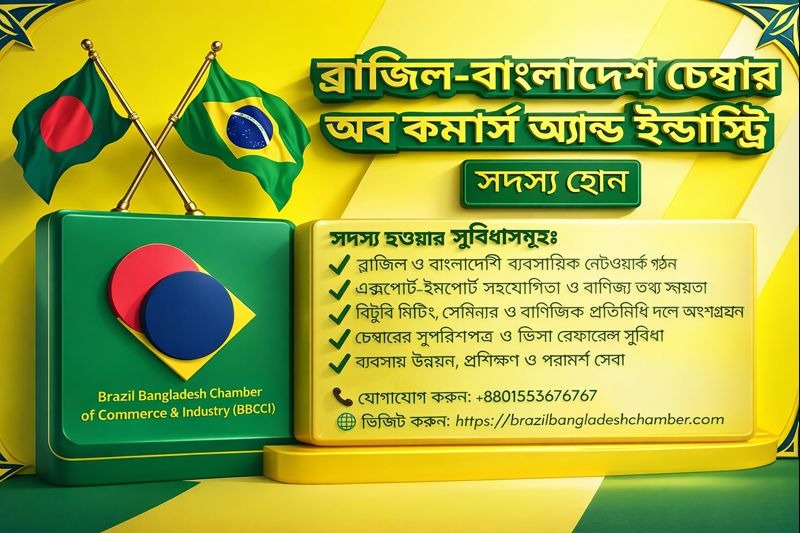
Membership Invitation to BBCCI for Bangladeshi and Brazilian Businesses
To fully capitalize on the growing trade opportunities, businesses from both Bangladesh and Brazil are invited to become members of the Brazil Bangladesh Chamber of Commerce & Industry (BBCCI). Membership in BBCCI is open to a wide range of stakeholders from large corporations and SMEs to individual entrepreneurs and other organizations all united by an interest in fostering Bangladesh–Brazil trade and investment[86][87]. By joining BBCCI, members gain access to a host of benefits and privileges designed to boost their success in the bilateral market.
Why Join BBCCI? Here are some compelling reasons and benefits for members:
- Access to Exclusive Networks: Members get entry into BBCCI’s extensive network of business leaders, policymakers, and experts from both countries[88]. This includes networking events with high-profile attendees (e.g. trade ministers’ visits, ambassador receptions, etc.) where you can make valuable contacts. Whether you are a Bangladeshi apparel exporter seeking Brazilian buyers, or a Brazilian agro company looking for Bangladeshi suppliers, BBCCI membership plugs you into the right circles for partnership development[89][90].
- Timely Market Intelligence: BBCCI provides members with up-to-date information resources – trade statistics, market research reports, regulatory updates, and business opportunity alerts[91]. For instance, as a member you might receive periodic briefs on Brazil’s economic trends or new import regulations that could affect your sector. This insider knowledge helps you stay ahead of the curve and make informed strategic decisions. Essentially, BBCCI becomes your go-to source for learning about any changes or prospects in the Brazil-Bangladesh trade space.
- Advocacy and Representation: As a member, your interests are represented via BBCCI in dialogues with government bodies and trade policymakers[92][93]. If you encounter regulatory hurdles or have policy suggestions (for example, recommending simpler customs procedures or pushing for duty concessions), BBCCI can voice these on your behalf in relevant forums. The chamber often engages with both governments to advocate for favorable trade policies, reduction of barriers, and resolution of bilateral trade issues. Your membership gives you a say (through the chamber) in shaping an environment conducive to business.
- Priority Participation in Events: Members enjoy priority invitations and discounted participation fees for all BBCCI events such as seminars, workshops, trade fairs, business delegations, and networking receptions[94]. This means you’ll have the first chance to join delegations to Brazil or host incoming delegations to Bangladesh. You can also exhibit in BBCCI pavilions at international expos or speak at forums as applicable. These events are golden opportunities to showcase your products, gather market feedback, and even sign deals. Non-members might have limited or more costly access, whereas members are at the forefront of these activities.
- Visibility and Credibility: Being a BBCCI member adds to your brand’s credibility as a committed player in the bilateral market. Members receive recognition in BBCCI’s publications and website directory, which can increase your company’s exposure[95]. For example, BBCCI often lists member profiles or success stories on their site and social media, effectively giving you free promotion. You can also use the BBCCI membership in your marketing (some companies mention it in their brochures or email signatures) to signal trustworthiness. Clients often take comfort knowing a company is part of a reputed chamber of commerce.
- Business Support Services: BBCCI offers direct support to members in their trade endeavors. This includes advisory on documentation and compliance, introductions to verified buyers/sellers, and assistance with trade inquiries[96]. If you’re struggling with a certain certificate or need help finding a logistics provider, you can reach out to the chamber for guidance. They may not solve every problem for you, but they will certainly point you in the right direction or connect you to someone who can help. In essence, you have a “helpline” for doing business in the Bangladesh-Brazil corridor.
BBCCI has various membership tiers to suit different entities for instance, Corporate Membership for companies, Individual Membership for professionals/consultants, and Associate Membership for partner organizations or NGOs[97][98]. This ensures that whether you are a large export house or a solo business consultant, you can find a membership category that fits and derive value.
Joining BBCCI is straightforward. We warmly invite interested businesses and individuals in both Bangladesh and Brazil to apply for membership. By becoming a member, you not only gain the benefits above, but also become part of a community dedicated to expanding Bangladesh–Brazil economic ties. This is a chance to actively contribute to and benefit from a flourishing bilateral trade relationship.
For membership inquiries or to learn more, you can contact BBCCI using the details provided below. The chamber’s team is ready to assist new members with the sign-up process, explain the fee structure, and answer any questions about how to engage with chamber activities.
BBCCI Contact Information
Brazil-Bangladesh Chamber of Commerce & Industry (BBCCI) for membership and support, you can reach out through the following channels:
- Phone: +8801553676767
- Email: sg@brazilbangladeshchamber.com
- Website: com
Feel free to call or email the BBCCI Secretariat (the Secretary General’s office) for any information regarding joining the chamber or upcoming events. The official website also contains news, event updates, and resources that can be useful to exporters and importers.
Closing Remarks
Exporting Bangladeshi products to Brazil represents a frontier of opportunity a convergence of Bangladesh’s manufacturing strengths with Brazil’s vast market demand. As we have seen, bilateral trade is on an upward trajectory, and both governments are keen to facilitate even greater exchange[20][17]. Bangladesh’s exporters, by exploring the Brazilian market, can diversify their customer base and reduce reliance on traditional Western markets. Brazilian importers and consumers, in turn, stand to gain access to competitively priced quality goods from Bangladesh from fashionable apparel and eco-friendly jute goods to leather products and pharmaceuticals. In the coming years, factors like Bangladesh’s LDC graduation and any new trade agreements will shape the landscape, but the fundamental complementarity between the two economies provides a solid foundation for growth.
Success in this endeavor will require Bangladeshi businesses to be proactive, well-informed, and adaptable. Exporters must commit to meeting Brazilian standards, understanding local business culture, and building relationships of trust. With proper preparation such as ensuring documentation is flawless, products are compliant, and logistics are efficiently managed even medium-sized Bangladeshi companies can make significant inroads in Brazil. On the other side, Brazilian companies interested in sourcing from Bangladesh should likewise engage actively, communicate their requirements clearly, and perhaps visit Bangladesh to see production capabilities firsthand (many have been pleasantly surprised by the scale and quality Bangladesh now offers). Initiatives like the BBCCI-organized Expo in São Paulo have already demonstrated the immense goodwill and curiosity that exists on both sides to explore partnerships[99][100]. It is an exciting time for Bangladesh–Brazil business relations, with early movers likely to reap substantial rewards as the ties deepen.
Finally, collaboration and support networks will be key. Organizations like BBCCI will continue to be a driving force in bridging gaps whether informational, cultural, or logistical – and in advocating for smoother trade processes. Businesses are encouraged to leverage such platforms and to share experiences with peers, so the collective knowledge base grows. Exporting is often a team effort, and having the chamber, fellow exporters, and official trade bodies in your corner can make a significant difference in overcoming initial hurdles.
In conclusion, Bangladesh and Brazil are poised to write a new chapter of South–South cooperation anchored in trade and commerce. The journey of exporting to Brazil may seem complex, but with diligence and the right support, it is highly achievable as evidenced by those who have pioneered the path. We encourage Bangladeshi exporters to take bold but informed steps into the Brazilian market and similarly invite Brazilian importers to tap into Bangladesh’s world-class production capabilities. By doing so, businesses in both nations will not only achieve growth for themselves but also contribute to a more robust and balanced partnership between Dhaka and Brasília. The prospect of shared prosperity through trade has never been brighter now is the time to seize it, with BBCCI and other facilitators ready to help you every step of the way. Here’s to the success of your Bangladesh–Brazil trade endeavors!
[1] [2] [3] [4] [6] [19] [20] [21] Bangladesh’s export to Brazil up 26% in FY25 | The Business Standard
https://www.tbsnews.net/economy/bangladeshs-export-brazil-26-fy25-1224566
[5] [7] [8] [10] [11] [12] [13] [14] [15] [16] [17] [18] [44] Trade Opportunities between Bangladesh and Brazil – Brazil Bangladesh Chamber of Commerce & Industry (BBCCI)
https://tradeandinvestmentbangladesh.com/trade-opportunities-between-bangladesh-and-brazil/
[9] [22] [23] [24] [25] [26] [27] [30] [31] [32] [33] [34] [35] [36] [38] [39] [40] [41] [42] [43] Brazil–Bangladesh Trade – Trade and Investment Bangladesh (T&IB)
https://tradeandinvestmentbangladesh.com/brazil-bangladesh-trade/
[28] [29] [37] [45] [46] [47] [48] [49] [50] [51] [52] [53] [54] [55] [56] [57] [58] [59] [60] [61] [62] [63] [64] [65] [66] [67] [68] Brazil Import Documentation Checklist for Bangladeshi Exporters – Brazil Bangladesh Chamber of Commerce & Industry (BBCCI)
[69] [70] [73] [74] [80] [81] [84] [85] Home – Brazil Bangladesh Chamber of Commerce & Industry (BBCCI)
https://tradeandinvestmentbangladesh.com/
[71] [72] [75] [82] [83] Our Services – Brazil Bangladesh Chamber of Commerce & Industry (BBCCI)
https://tradeandinvestmentbangladesh.com/our-services/
[76] [77] [78] [79] [99] [100] Made in Bangladesh Expo 2025 Impact – Brazil Bangladesh Chamber of Commerce & Industry (BBCCI)
https://tradeandinvestmentbangladesh.com/made-in-bangladesh-expo-2025-impact/
[86] [87] [88] [89] [90] [91] [92] [93] [94] [95] [96] [97] [98] Membership – Brazil Bangladesh Chamber of Commerce & Industry (BBCCI)
